


Vacuum drying and freeze drying both operate under low-pressure conditions, appearing similar at first glance. However, they differ fundamentally in production efficiency, product structure, and energy use. Improper drying solution can result in limited production capacity or customer complaints due to substandard quality.
This article will rovide a detailed comparison of vacuum drying and freeze drying across 9 aspects, helping you select a suitable drying solution.
What is Vacuum Drying

Vacuum drying allows materials to evaporate moisture at lower temperatures through heating in a vacuum environment. During the drying process, materials are often placed on heated shelves or trays, receiving continuous heat via conduction. Water vapor is extracted by a vacuum pump and recovered through a condensation system.
What is Freeze Drying

Freeze-drying involves freezing the material and then slowly heating it in a high vacuum environment. At this point, the ice does not melt into liquid water but instead sublimates directly from a solid state into water vapor, and is then collected by the condensation system. It helps you preserve the original structure and activity of the product, and is suitable for high-value and highly sensitive products.
9 Main Differences Between Vacuum Drying and Freeze Drying
Drying Method
Vacuum Drying: By reducing pressure, water can evaporate at a lower boiling point, thus achieving material drying. This process relies on conduction heat transfer, where heat is usually transferred from a heating plate through the container wall to the material.
Freeze Drying: The material is frozen, then in a high vacuum environment, moisture sublimates from solid ice crystals directly into water vapor without passing through a liquid phase. Consequently, it causes minimal damage to the material structure and active components.
Operating Temperature & Pressure
Vacuum Drying: The working temperature is generally between 30°C and 80°C, and the pressure is usually within the range of several kPa and several hundred kPa. By reducing the system pressure and temperature, it is possible to accelerate the evaporation of moisture in your materials. Although the temperature is lower than atmospheric pressure drying, it still belongs to the category of thermal drying.
Freeze Drying: The temperature usually ranges from -50°C to -10°C, keeping the material in a frozen state. The system pressure is extremely low, typically below 100 Pa. This extremely low-pressure environment is necessary for forced sublimation.
Drying Time

Vacuum Drying: The drying time of a vacuum dryer is relatively short, ranging from a few hours to about ten hours. Because the evaporation rate of liquid water is fast, especially under thin material layers or stirring conditions, the moisture removal rate is significantly faster than freeze-drying.
Freeze Drying: This drying method takes a longer period of time, requiring 24 to 48 hours, and for some biological products, it can even be longer. It involves freezing, sublimation and desorption drying, and each step cannot be too fast, otherwise, it is easy to affect the quality of the final product.
Footprint and Production Capacity
Vacuum Dryer: The equipment has a compact structure and is suitable for projects with limited factory space. Common types include vacuum ovens, double-cone vacuum dryers, and rake-type vacuum dryers. Vacuum dryers have a high degree of integration of the vacuum system and heating system, allowing them to be directly incorporated into your existing production line. Additionally, their batch capacity ranges from tens of kilograms to several tons, so it is suitable for medium to large-scale production.
Freeze Dyer: Its footprint is usually larger than that of a vacuum dryer because it requires auxiliary units such as a refrigeration system, condenser, vacuum pump, and electrical control system. The shelf structure also makes the freeze-dryer body larger in height and length. Unfortunately, the processing capacity of a single device is relatively limited. If you want to expand production capacity, you have to connect multiple devices in parallel, which dramatically increases the footprint. Therefore, freeze drying machine is ideal for small-batch production of high-value-added products.
Dried Product Structure
Vacuum Drying: Since liquid water is expelled through vaporization, the capillary pressure causes your material to undergo physical contraction and hardening. Therefore, the final product often presents a dense and hard structure, and its volume will also significantly decrease. This also makes it convenient for you to carry out subsequent packaging and transportation.
Freeze Drying: After water sublimation, the product develops a porous, sponge-like structure. It retains its original shape and volume, with almost no shrinkage. The loose pores facilitate rehydration. However, extra care is needed during transport to prevent breakage from impacts.
Final Product Quality
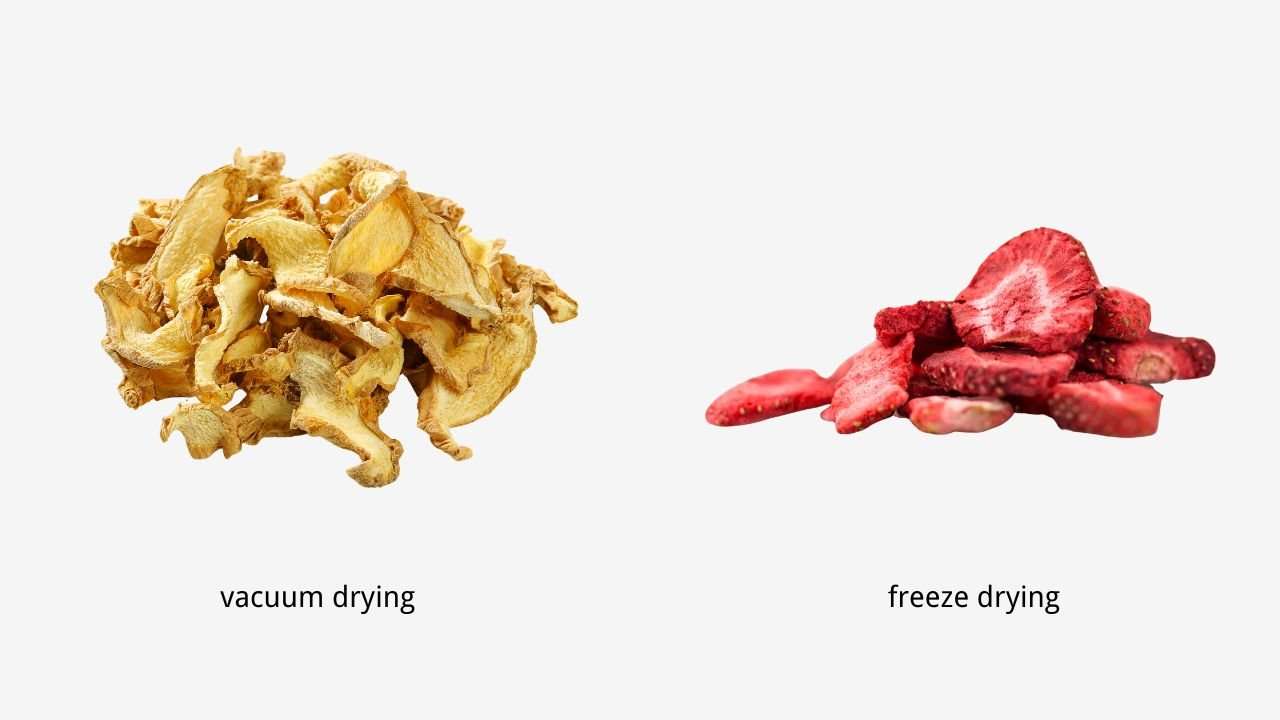
When evaluating the quality of the dried finished product, you should focus on flavor changes, loss of heat-sensitive components and nutrients, and the impact of final moisture content on storage.
Flavor and Nutrient
Vacuum Drying: Vacuum can reduce the risk of your materials oxidizing. However, heating still causes the loss of some volatile flavor substances and heat-sensitive components, such as vitamins and active peptides. Heat also promotes the Maillard reaction, making your product firmer in texture and darker in color. Of course, you can balance quality and production efficiency by optimizing temperature parameters and drying time.
Freeze Drying: Because the temperature is extremely low throughout the drying process, the material is hardly damaged by heat. It can help you retain at least 95% of the flavor, color, and nutrients, and the texture is crispy.
Final Moisture Content
Vacuum Drying: The moisture content of the final product is generally between 3% and 5%. It can meet most of your industrial storage and processing needs.
Freeze Drying: The moisture content can be easily controlled at 1% or even lower. Combined with sealed packaging, it can ensure that your products have a maximum shelf life of 25 years with exceptional quality stability.
Energy Efficiency
Vacuum Drying: The energy consumption of a vacuum dryer is mainly in heating and maintaining the vacuum, and the energy efficiency ratio is relatively high. In addition, due to the short drying time, the cost per kilogram of drying is low, making it suitable for long-term continuous operation.
Freeze Drying: This drying process requires substantial energy for refrigeration, vacuum pump operation, and heating. As a result, the energy utilization rate is low, and the power loss is several times that of vacuum drying.
Equipment and Operating Cost

Vacuum Drying: The initial investment for the equipment is moderate, and the maintenance cost is not high. Moreover, because vacuum dryers have a simple structure, they require minimal operator training. Therefore, it has a high cost-performance ratio and quick capital recovery.
Freeze Drying: Freeze dryers include vacuum pumps, refrigeration systems, and condensers, resulting in higher equipment costs and time-consuming maintenance. High electricity costs also increase operating expenses. Therefore, this method is only cost-effective for high-profit products with extremely high quality requirements.
Typical Applications
Vacuum Drying
Widely used in chemical intermediates, food ingredients, plant extracts, and pharmaceutical raw materials, suitable for a large-scale production project.
- Dried fruits, sauce powder, grain particles, candied fruits.
- Chinese medicine extract, heat-stable chemicals.
Freeze Drying
Primarily used for vaccines, biological agents, premium nutritional supplements, functional foods, and other applications demanding exceptional quality.
- Freeze-dried coffee, pet snacks (raw meat), high-end fruits, instant bird’s nest.
- Serum, probiotic strains, heat-sensitive APIs, laboratory samples.
Comparison Table: Vacuum Drying vs. Freeze Drying
| Aspects | Vacuum Drying | Freeze Drying |
| Drying Method | Water evaporation under reduced pressure with heating | Freeze and sublimation under high vacuum |
| Operating Temperature & Pressure | Low to Medium temperature, moderate vacuum level | Very low temperature and high vacuum |
| Drying Time | Shorter | Longer |
| Footprint and Production Capacity | Compact footprint, higher throughput | Large footprint, small-batch production |
| Dried Product Structure | Dense structure | Highly porous structure, best shape retention |
| Final Product Quality | Good | Excellent |
| Flavor and Nutrient | Partial loss due to heat exposure | Maximum retention of flavor, nutrients, and bioactivity |
| Final Moisture Content | Usually 3% – 5% | 1–3% or lower |
| Energy Efficiency | Higher | Lower |
| Equipment and Operating Cost | Lower | Higher |
| Typical Applications | Chemical intermediates, plant extracts, food ingredients | Vaccines, biologics, proteins, probiotics, high-end foods |
How to Select Between Vacuum Drying and Freeze Drying

When to Choose Vacuum Drying
The more of the following conditions align with your product and production requirements, the more suitable vacuum drying becomes.
- Moderate temperature sensitivity: Tolerates 40–80°C without significant degradation from mild heating
- No strict appearance requirements: Allows for shrinkage and densification; does not require a porous, fluffy texture
- Limited budget: Equipment investment, operational energy consumption, and maintenance costs must be manageable
- Pursue Higher throughput: Easier scale-up from pilot to industrial production, suitable for continuous or semi-continuous processing
- Final moisture content is generally acceptable: Target moisture levels of 3–5% are sufficient
- Rehydration quality is not critical: Product is primarily for further processing rather than direct rehydration consumption
In short, if you focus on cost-effectiveness, throughput, and process stability, vacuum drying is the practical and industrially friendly choice.
When to Choose Freeze Drying
The more of the following conditions are met by your product and production requirements, the more suitable it is for freeze-drying.
- The material is highly sensitive to temperature: extremely sensitive to temperature, heating will cause inactivation or denaturation.
- The active ingredients must be retained: proteins, enzymes, vaccines, biological products, probiotics
- The product structure must be intact: porous, fluffy, and not collapsing
- Key indicators for rehydration performance: need to rehydrate quickly and completely, and the shape should basically recover
- Extremely low moisture content requirement: usually ≤1%, to extend shelf life
- High unit price and high added value: acceptable for high equipment investment and operating costs
If your product has high profit margins, is sensitive to heat, prone to deactivation, and you place greater emphasis on quality, then a freeze dryer is almost the only reasonable option.
FAQ
Is a Vacuum Dryer Cheaper than a Freeze Dryer?
Yes, the total cost of a vacuum dryer is usually lower. On the one hand, the purchase cost of vacuum drying equipment is lower, typically only 40% of that of a freeze dryer. On the other hand, freeze-drying requires freezing the material first and then sublimation, which takes a long time and consumes a great deal of electricity. In contrast, vacuum drying machines have lower operating costs.
What Is the Difference in Rehydration Between Vacuum Drying and Freeze-Drying?
Freeze-dried products outperform vacuum-dried ones in both rehydration speed and quality. Freeze-dried materials often exhibit a loose, porous structure, allowing water to penetrate rapidly and restore them to their original state.
Vacuum drying, however, makes the product structure denser, with fewer internal pores, so water penetrates more slowly. Consequently, its rehydration speed is slower and may lead to clumping.
Which Method Offers Better Shelf Life, Vacuum Drying or Freeze-Drying?
Freeze-drying. Freeze-drying removes water through sublimation at low temperatures, reducing the product’s moisture content to extremely low levels. It helps inhibit microbial growth and chemical reactions.
Although vacuum drying can also extend shelf life, it is not as protective of heat-sensitive components or as effective in controlling the moisture of the product as freeze-drying. Therefore, the shelf life of vacuum-dried products is shorter than that of freeze-dried products.
Which Is More Suitable for Pharmaceuticals and Biological Products?
Freeze-drying is more suitable. Since freeze-drying processes materials under low-temperature, low-oxygen conditions, it maximizes the protection of sensitive components’ activity and structural integrity. It is often used for vaccines, proteins, enzymes, and probiotics. Vacuum drying, however, carries risks when handling certain highly sensitive biomolecules and is more suitable for plant extracts and chemical raw material powders.
Are Freeze-Dried Products Completely Immune to Spoilage?

No, freeze-dried products are not completely immune to spoilage. If the product packaging is damaged and absorbs moisture from the air, it will promote microbial growth and cause spoilage. Therefore, for highly hygroscopic and easily oxidized products, you can use aluminum foil bags or nitrogen-filled sealed packaging to extend their shelf life.
Pilotech— Professional Lab& Pilot-Scale Spray Dryer Supplier in China

Both vacuum drying and freeze drying have relatively long processing cycles, while a spray dryer can turn your liquid material into powder in just a few minutes, resulting in uniform particle size and easier dissolution.
We offer laboratory and pilot-scale spray drying machines, allowing you to quickly test different formulations and parameters, saving you time and effort.
Contact us now for more information.
