


Spray dryers, as exceptional and reliable as they are, are not without their share of problems. This includes inconsistent particle size and subpar drying performance. But what really causes this? Most manufacturers attribute such problems to incorrect settings and faulty components.
However, in most instances, this is a symptom of a poorly designed drying chamber. Below, we look at how the spray dryer design impacts drying performance and how manufacturers can optimize it to reduce operational costs and improve powder quality.
What is a Spray Dryer Chamber?

A spray dryer chamber is a specialized vessel equipped with customized features that facilitate the conversion of liquid or pasty raw material into dried powder. It achieves this by exposing atomized raw materials like fresh milk to heated air, consequently initiating the evaporation process.
Spray dryer manufacturers customize their sizes and design in order to suit the characteristics of different feeds and the drying requirements of different manufacturers.
How the Spray Dryer Chamber Influences Drying Efficiency

Manufacturers across industries producing or processing powdered products, ranging from powdered baby formulas to granulated chemicals, cite spikes in moisture content as one of the most prevalent problems with industrial spray dryers.
Whilst this could be a consequence of multiple issues, spray dryer manufacturers and technicians cite chamber design as the primary cause of reduced spray dryer drying efficiency. The right spray dryer chamber design facilitates;
- Improved Heat and Mass Transfer: Well-designed spray dryer chambers translate into a bigger surface area, consequently maximizing heat and mass transfer. This ultimately helps manufacturers maximize their yields.
- Complete Moisture Evaporation: Spray dryer chambers with the perfect height-to-diameter aspect ratio boast greater heat transfer, and this guarantees manufacturers greater powdered product quality.
- Consistent Particle Size: The key to uniform powder particles and a consistent moisture content lies in the correct engineering of the drying chamber. This consequently helps brands build a great reputation, ultimately retaining their customer base.
- Increased Powder Recovery: A well-designed drying chamber reduces powder buildup on the chamber’s walls while ensuring there is a seamless exit for the dried product. This spikes the yields of manufacturers, ultimately skyrocketing their profitability.
Design Factors that Optimize Spray Dryer Performance

· Chamber Diameter
Chamber dryers with a relatively smaller diameter-to-height aspect ratio are more likely to experience wall caking since the atomized droplets are more likely to contact the chamber’s wall before they are completely dried. This explains why premium industrial spray dryers are endowed with relatively larger diameters. The larger diameters not only increase the surface area for the atomized droplets but also increase the residence time.
· Chamber Height
The height of a drying chamber essentially determines how much time is needed to dry the atomized particles fully. Spray dryers with relatively taller drying chambers boast longer residence times, and this ultimately translates into improved moisture evaporation. However, a balance must be struck between the chamber’s height, the expected feed properties, and inlet air temperature to guarantee optimal moisture extraction.
· Cone Angle and Powder Discharge
Spray drying chambers come with an inclined section at the base, and the design of this section ultimately determines how efficient the spray dryer is in recovering and dispensing the powder. Drying chambers with perfectly angled cone angles hardly experience wall caking, given that the powder flows seamlessly as it makes its way to the collection tank.
· Air Distribution System
Spray dryer airflow design revolves around the configuration of the air distribution system, which ultimately dictates the spray drying process. Spray drying machines with an elaborate and well-engineered air distribution system boast an even droplet trajectory and superior heated air distribution. This ultimately results in even moisture evaporation and guarantees consistent particle size.
· Air Velocity and Flow Uniformity
Whereas high air velocity is needed to accelerate the moisture removal process and dry the feed, caution must be exercised to prevent agglomeration among other heat-related problems. Subjecting the feed to excessive air velocity raises the risk of agglomeration and increases the likelihood of particles sticking to the walls of the drying chamber. It can also distort the integrity and makeup of the products being dried.
Optimizing Airflow Patterns for Better Drying

· Co-current Airflow
Otherwise known as parallel airflow, this airflow pattern is revered for its initial rapid drying. It involves injecting the incoming heated air as well as the feed material flow in a similar direction. This makes it possible for the hottest air to dry the wettest raw material, consequently optimizing the drying process. Co-current airflow, however, is not recommended for products with relatively higher heat sensitivity.
· Counter-current Airflow
Counter-current airflow is quite common in industrial spray driers, and this is because it guarantees a more uniform drying process. Spray dryers utilizing this airflow pattern have the incoming heated air flowing in the opposite direction to the feed material. This creates a scenario where the wettest feed first comes into contact with the hottest incoming air.
· Mixed-flow Airflow
Mixed-flow airflow offers the most efficient drying performance, and it combines both the parallel and counter-current airflow patterns. First, the liquid material is fed into the drying chamber from the bottom, and as it flows upwards, it comes into contact with heated air feed from the chamber’s top.
After a while, the roles are reversed, and the hot air is injected from the drying chamber’s bottom while the liquid feed flows from top to bottom. This airflow pattern is recommended for manufacturers producing or packaging heat-sensitive products.
Matching Chamber Design with Atomization Technology

A perfectly designed spray drying chamber can perform dismally if integrated with the wrong atomizer. Therefore, it is essential to match the right chamber design to the perfect atomizer.
· Rotary Atomizers
Rotary atomizers thrive in spray drying machines customized for slurries or liquid raw materials with a high volume of suspended solids. As such, they demand a relatively longer residence time, which is determined by the drying chamber’s design. Most dryers with rotary atomizers feature tall but narrow drying chambers, and this facilitates a longer residence time, ultimately optimizing moisture evaporation and powder recovery.
· Pressure Nozzles
Spray dryers utilizing pressure nozzles for atomization are best suited to drying raw materials with defined particle characteristics. For optimal performance, they necessitate a dryer design that can withstand pressure fluctuations as well as orifice wear.
· Two-fluid Nozzles
Two-fluid nozzle spray drying systems are perfect for liquid feeds that are highly sensitive to heat and require finer atomization. These dryers function optimally when paired with drying chambers that have a relatively narrower diameter. Furthermore, they thrive when customized to exploit a co-current airflow pattern.
Common Spray Dryer Design Challenges and How to Solve Them

| Common Challenges | Possible Solution | Possible Optimization Strategy |
| Incorrect Chamber Geometry | · Match the chamber geometry to the atomization technology used. | · Run CFD simulations in the designing phase. |
| Mismatched Airflow Pattern | · Utilize an airflow pattern best suited to the liquid feed. | · Make use of adjustable air disperser vanes. |
| Lack of Adequate Thermal Recovery | · Make use of premium-quality heat exchangers. | · Use waste heat to pre-heat the feed. |
| Poor Atomization Selection | · Pick the right atomizer for specific types of feeds. | · Liquid feed pre-conditioning. |
FAQs

How does chamber design influence powder quality?
Spray dryers with a custom-built drying chamber guarantee premium quality powders characterized by a consistent particle size. It allows the even and controlled distribution of heat while preventing wall caking and heat damage.
How do you choose a spray dryer chamber for specific applications?
To find a spray drying chamber that optimizes the performance of a spray dryer and guarantees greater powder quality, manufacturers must first determine the feed’s characteristics and the respective production requirements.
What is the ideal spray dryer chamber shape?
The ideal shape and size for a spray dryer chamber depends on the type of feed being dried and the atomization technology being used. For instance, a tall, narrow, cylindrical shape is regarded as the best for heat-sensitive feeds.
When should you choose a custom spray dryer chamber design?
A custom spray drying chamber guarantees a drying solution tailored to the respective needs of the manufacturer. Manufacturers handling unique liquid feeds or with unusual production demands would benefit greatly from custom dryers rather than standard spray dryers.
Which material is best for a spray dryer chamber?
The ideal spray dryer chamber material boils down to the specifics of the application. For instance, borosilicate glass is considered the best material for laboratory spray drying, while stainless steel is favored when it comes to industrial drying.
Can spray dryer chamber design reduce energy consumption?
Yes. Greater emphasis is placed on the design of the spray drying chambers because it directly impacts the energy bills of manufacturers. Well-engineered chambers prevent heat loss, ultimately lowering the energy bills of manufacturers and packaging companies.
Final Thoughts
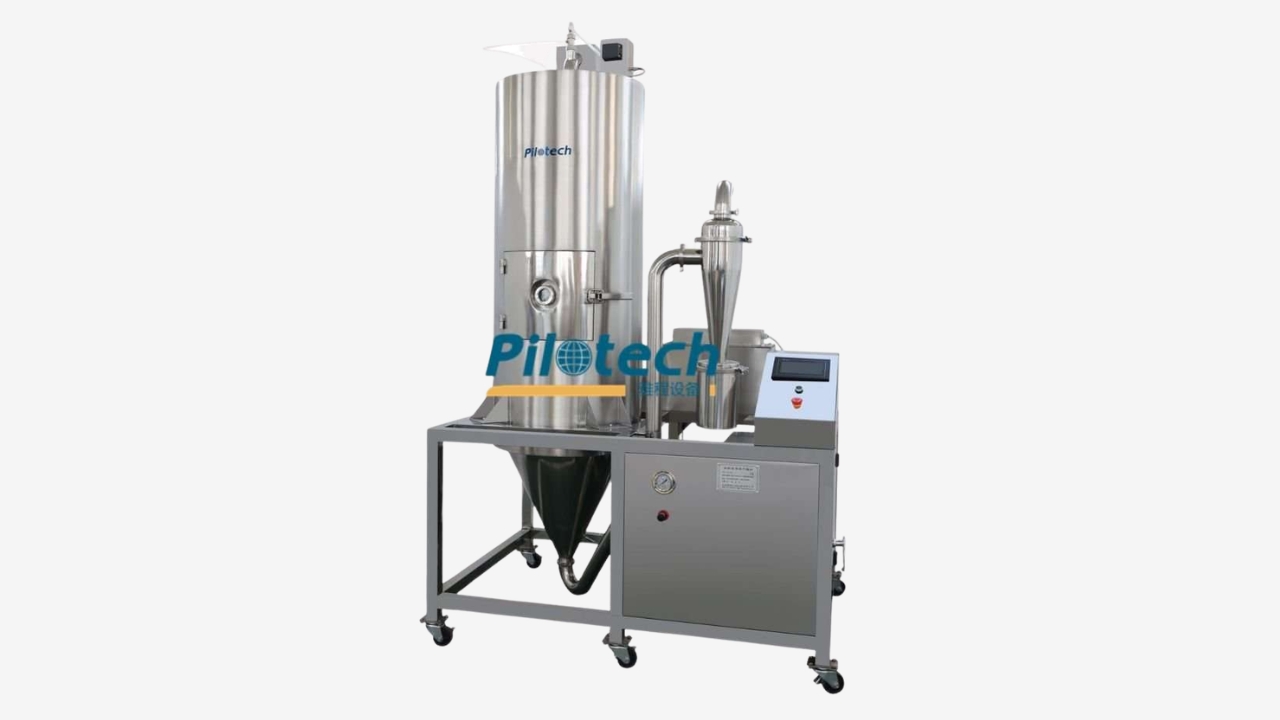
At Pilotech, we have helped many material processing industries optimize their spray drying performance. Apart from customizing the drying chamber, our engineers will help you choose the right spray dryer nozzle type, alongside other spray dryer specifications.
Contact our technical team today, for customized spray dryer solutions.